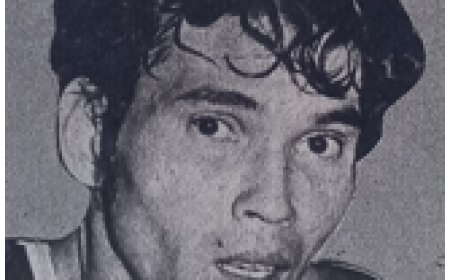
Edgardo 'Kalembang' Fulgencio, a nobody 58 years ago but later made a name for himself in local hoopdom, is one of five policemen who saw action in the World's Olympics. Besides, he is one of those basketball greats who can play all three positions - forward, center and guard - in spite of his five feet nine inches frame. Ding, as he is called by his friends before he was teased "Kalembang,' made the Philippine team in the 1948 London Olympics along with Gabby and Fely Fajardo, Ramoncito Campos, Eddie Decena, Francisco Vestil, Andy de la Cruz, Manolet Araneta, Pocholo Martinez and Lauro Mumar. The other flatties were Jess Marzan (1936 Berlin); Jose Go-changco and Antonio Tantay, (1952 Helsinki); and Manny Jocson (1964 Tokyo). Ding, in his lifetime basketball career, almost made it a grandslam like Mumar as he also refereed and coached the game aside from playing it but never had the chance to teach it. Besides, in playing, he had a variety of shots seldom seen among our present players, from the drive (jackknife, the jump and set (one and two-hand flips) to the hook (the most difficult to perfect, the hardest to block). When he retired from active competition in 1952, he helped form the Basketball Referees Association of the Philippines and later organized the Recognized Basketball Officials of Manila and was elected as its first president. Fulgencio's basketball career started in 1933 at the age of 16. Together with Jess Marzan, Anong Manlulu, Skip Agcaoili and the Yang brothers - Saturnino and Filomeno, he powered the Columbian Institute in the Manila Athletic Association of Secondary Schools basketball title. He transferred to Jose Rizal College and made the team in 1937. Then came the last war and at the age of 24, Ding was recruited by Skip Guinto, son of then Mayor Leon K. Guinto to join the Manila Flatties team along with Bobby Jones, Totong Martinez, Franco Marquicias, Fely Fajardo and Guinto himself. It was so strong that the team ruled all tournaments in Manila during the Japanese Occupation. Fulgencio was just destined to be in champion teams. During Liberation, in 1946, he joined the famed Maurice Enterprise squad owned by a former Gl and his team won the first MICAA cham-pionship. His teammates then were Andy de la Cruz, Francisco Calilan, Cesar Baldueza, Wenceslao Modesto, Antonio Tantay, Skip Agcaoili, Abe vedillo, William Nicolai and Jim Turner, two other GI's.

They beat the star-studded Sampaguita Pictures quintet which had as its nucleus three sets of brother-combination: Gabby and Fely Fajardo; Cady and Tacing Tanquintic; and Luis and Jose Gavieres; plus Ramoncito Campos and Francisco Vestil. The wandering bug and his fierce ambition to get a degree made Ding rejoin the Heavy Bombers in 1947. By 1948, JRC Coach Mateo Adao has moulded a fighting team made up of Ful-gencio, Calilan, Avedillo, Fidencio Ylagan, Ricaredo Calvo, Fabio Santos, Andres Cruz, Boy Ciesneros, Guillermo Victoria, Jose Cabusao and Pedro Teodoro to capture the championship after a 15-year campaign. The NCAA championship was the stepping stone for Ding to make the 1948 London Olympics. Came 1949 and Fulgencio was not qualified anymore to play in the NCAA for having played four years, so he went to Far Eastern University. But he had to undergo the one-year residence, so in the meantime, he played for Heacock's in the MICAA under Franco Marquicias, his tutor. The same year he was with Caloy Loyzaga, Juanito Buenaflor, Eddie Lim and Pons Saldana when the Kai Ming Press team swept its eight-game series in Taipei and Hongkong.
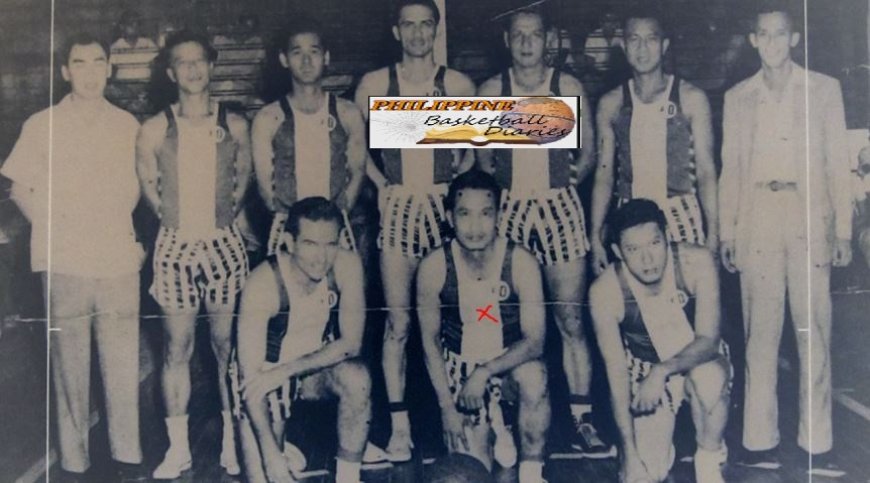
Teaming beautifully with London Olympics teammate Andy de la Cruz, Fulgencio helped power the FEU Tamaraws to the 1950 UAAP championship, the first for the institution in a quarter of a century. It was also a double for the Tams as they also won the national intercollegiate diadem When he got his commerce degree in 1952, he announced his retirement and transferred from the court to the bench when he mentored the Tamaraws to second place in the UAAP. Going back, Ding was a frail boy when he enrolled at the Gagalangin Elementary School in Tondo. He was one of the skinniest boys in school and although he was five nine, he weighed 125 pounds. His built then was similar to that of Lawrence Mumar today, even thinner., But his lean build was just a camouflage for the energy, fighting spirit and guts underneath. For his basketball knowhows, Ding gives credit to Old Man Franco who was his neighbor in Tondo. He learned the fundamentals, finer points and tricks of the game from Franco. Fulgencio just could shoot. His favorite was positioning or what we call now, jockeying for position. He was always a split second ahead of his guard, scoring from under when he's playing center, laying up as a forward and connecting from outside as a guard. He was also a playmaker. If he finds a chance, he will drive for the basket with a hook if the opponent is exceptionally good. In 19 years of playing, Fulgencio lost his composure only once and that was in the best of three-play-off for the 1950 UAAP champion-ship. The Tams won the opener and in the second game, FEU Coach Martin Dino fielded Fulgencio as a forward. Since he was a deadly forward, it was but fitting for UST to assign a deadly forward and who could do this be but none other than Paeng Hechanova, Ding's teammate in London. True enough, Hechanova stuck to Fulgencio and in two quarters, limited the FEU ace to two points. Only in the last quarter when Pang tired a bit that Fulgencio was able to score another goal for a final four-point output. But Ding vindicated himself when he scored 12 points in the rubber match to give FEU the title. He mentored the Tams to second place in the 1952 UAAP championship. Later, he transferred to coach Philippine National Bank and then to Fil-Hispano in the ESAP league. His teams won. Then he concentrated in officiating and in 1965, he was appointed physical education director of Lyceum of the Philippines and coached the varsity team to one UCAA championship, and the Baby Pirates to two titles. He then went to Philippine College of Criminology in 1970, first as a coach and mentored the Red Panthers to four straight championships in the PCAA tournament. At present he is the athletic director of PCCR. With basketball blood still in his veins, Ding, on rare occasions don his uniform during exhibition games. In 1955, he played for a brief period in the 1955 Professionals' Invitational Basketball Association league with the late William Li Yao's Asian Surety Super Stars and with the PCCR Faculty in the Colleges-Universities Faculty AA tournament. That, in a nutshell, is the career of another basketball great who at the age of 58 is still going strong and plays an active part in the sports he loved when still a kid. To conclude, out of the five 'Policemen Olympians,' three came from the Manila Police Department - Fulgencio, Marzan and Gochangco; one from the Makati PD, Manny Jacson and one from Quezon City Police Department, Tony tantay – E. R. T.

 Aris Garcia